
NSD Lab
Where Ideas Become Evidence
Some questions are too new to solve from a slide deck. NSD Lab is where we explore emerging technologies through research, simulation, prototypes and real-world experiments, turning promising ideas into evidence before they become products, services or client capability.
We use the Lab to test assumptions, understand constraints and learn where new technologies genuinely create value.
 Drone
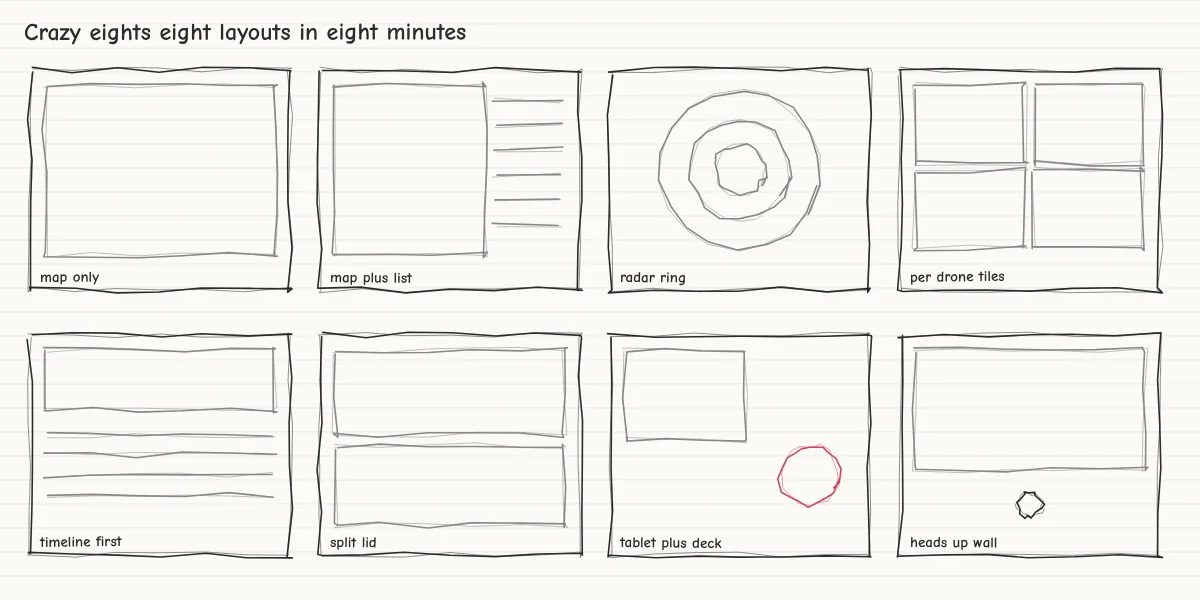 Sketches
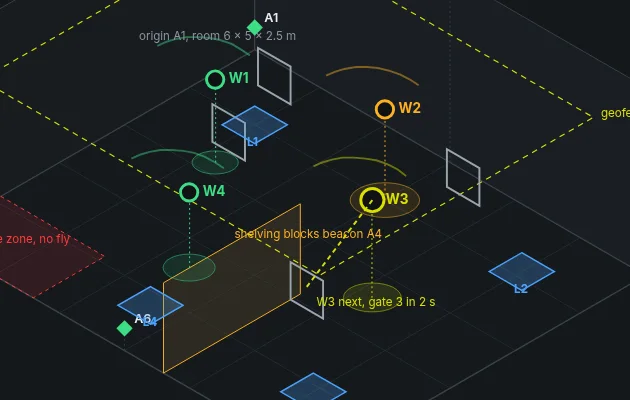 Flock map
 Hardware
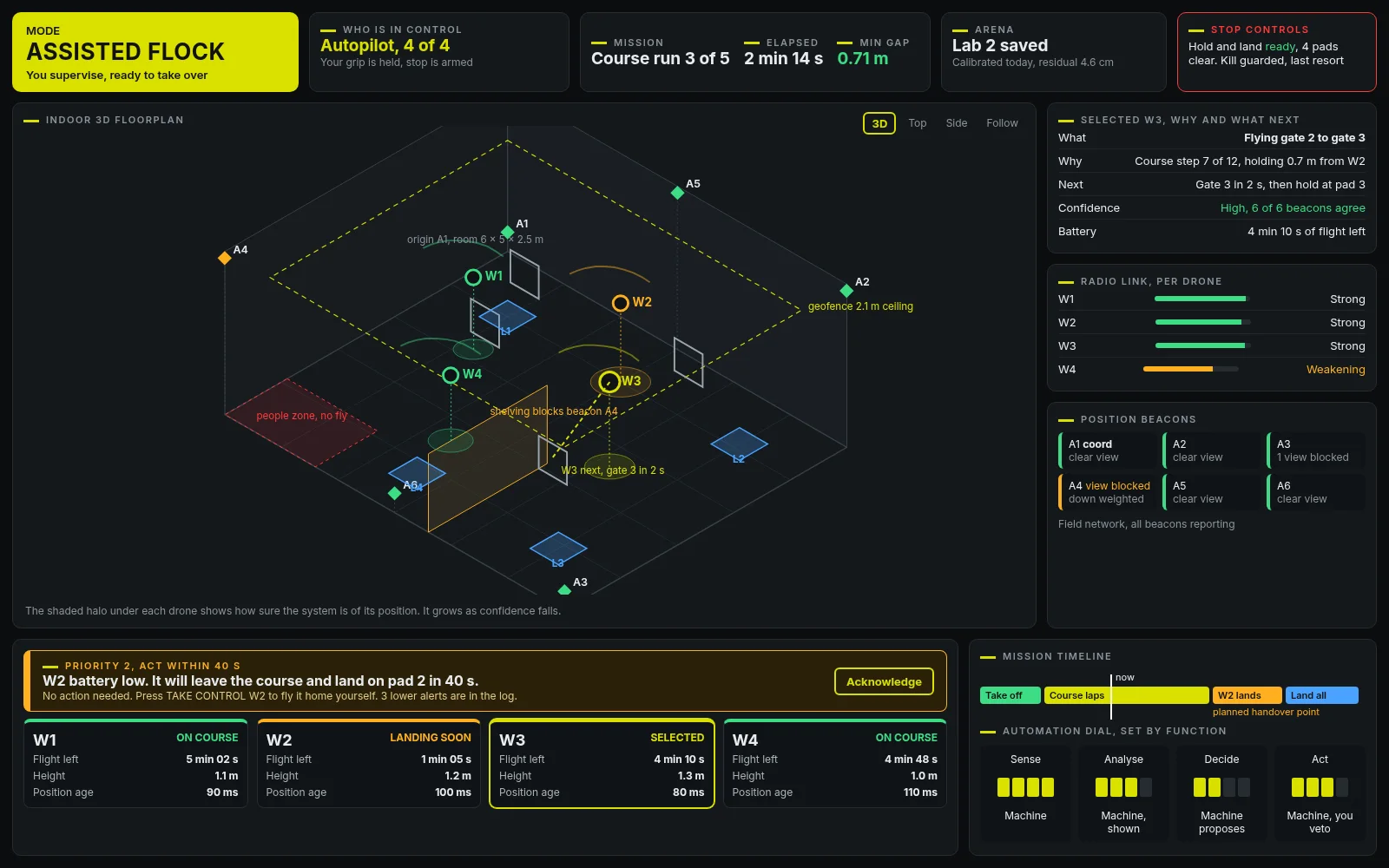 Console UI
Research is how we learn before the stakes are real.
01 / ACTIVE RESEARCH
Agentic Authority Boundary
How far should autonomous reasoning be allowed to become action?
An architectural approach for governing how far autonomous reasoning is permitted to become operationally binding. Explored through formal modelling, executable rules, simulation and evaluation.
Patent pending. The current patent application is personally owned by Richard Knuszka.
Current investigations
Current investigations
Investigation 02. Status · Exploring
Collaborative Autonomy
Can multiple autonomous vehicles maintain a shared mission when communications or individual vehicles fail?

What we’re testing
- Distributed state and coordination
- Task reallocation
- Degraded communications
- Peer confirmation
- Mission continuity
More about this investigation
We are engineering a mission control approach that lets a flock of small uncrewed aircraft share one picture of a task, divide the work and adjust as conditions change, rather than being flown one by one.
Flocks of mini drones in a confined space make an ideal test bed for coordination, safe separation and shared tasks. Operators set the mission and its limits, and the link to our Agentic Authority Boundary work defines what each aircraft may decide for itself. Ideas are tested in simulation first, then in controlled field trials.
Email usInvestigation 03. Status · Exploring
Indoor Autonomous Flight
How can small aircraft understand and navigate an indoor space without GPS?

What we’re testing
- UWB positioning and indoor tracking
- Real-time control
- Calibration
- Positioning confidence
- Hardware in the loop testing
More about this investigation
UWB, or ultra wideband radio positioning, uses short radio pulses between fixed anchors and a tag on the aircraft to estimate position where GPS is unavailable or unreliable.
This thread also covers onboard edge compute, dockable VTOL research and hardware in the loop testing, so software can be proven against real components before it flies. No results are published yet.
Email usInvestigation 04. Status · Experiment published
Distributed AI at the Edge
What happens when intelligent systems have limited compute, power and connectivity?

What we’re testing
- Distributed inference
- Constrained compute
- Intermittent connectivity
- Latency
- Edge architecture
- Practical deployment limits
More about this investigation
We run modern AI models across several smaller machines rather than one large server, and measure what that means for speed, cost and reliability.
The One Model, Many Machines series on Bench to Sky documents a real experiment on the bench, splitting one language model across two Macs and recording what worked, what did not and why.
Email usInvestigation 05. Status · Design study published
Human Supervision of Autonomous Systems
How does one person meaningfully supervise several autonomous machines without becoming another dashboard operator?
What we’re testing
- Mission-level interfaces
- Attention and workload
- Exception-driven interaction
- Confidence and uncertainty
- Handover
- Progressive disclosure
More about this investigation
A design study for a portable drone console, worked through in sketch rounds and scenario walkthroughs of a small flock, including take over and degraded moments.
Two Insights pieces turn this evidence into a broader design argument.
Also on the benchApplied computer vision. Real-time object detection, low latency perception for autonomous systems, and swim and sports analytics. ExploringBench to Sky projects (opens benchtosky.com)
From research to capability
A real example, from question to impact
Research follows a continuous path, from questions through studies and evidence to prototypes and real-world capability.
Explore more research storiesQuestion
Can an operator supervise several autonomous drones without monitoring each one individually?
Study
Scenario walkthroughs of a three drone flock, including take over and degraded moments.
Observation
Taking over the whole flock penalised drones that were fine, and per drone detail competed for attention.
Prototype
A mission-level console concept with exception-driven drill down.
Insight
Show the mission before the machinery.
Application
Human-centred UI patterns for autonomous systems.
Bench to Sky
Our engineering incubator
Research becomes more useful when it meets real hardware. Bench to Sky is where we build, break, simulate and test ideas before they become claims.
It gives NSD a practical environment for exploring UAVs, robotics, AI, sensing, positioning, interfaces and autonomous systems.
Explore Bench to Sky
- Simulation + hardware
- UAV / AI / Robotics
- Edge compute + sensing
Latest outputs
Latest outputs
Experiment
One Model, Many Machines (opens benchtosky.com)
Distributed inference on edge hardware, published on Bench to Sky.
Design study
We Don’t Want Another Dashboard
Designing operational interfaces around decisions and attention.
From investigation to real-world capability
Explore our latest thinking in Insights, or talk to us about a research-led project where emerging technology could create real value.